
Introduction
Search Engine Optimization (SEO) is one of the strongest ways to bring organic traffic to your website. But when people start learning SEO, the biggest confusion is between On-Page SEO vs Off-Page SEO. Both are essential for ranking, but they play very different roles.
In this blog, we’ll break down what each one means, how they work, and what actually matters more in 2025.
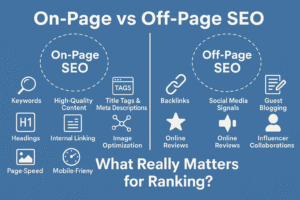
What Is On-Page SEO?
On-Page SEO refers to everything you optimize inside your website. These are elements you fully control.
Key components of On-Page SEO:
-
Keyword Optimization
Using the right keywords in titles, content, URLs, and headings. -
High-Quality Content
Well-researched, original, and valuable articles that answer user intent. -
Title Tags & Meta Descriptions
These help search engines and users understand what your page is about. -
Headings (H1, H2, H3)
Structuring your content to make it readable. -
Internal Linking
Linking to your own pages to improve navigation and boost SEO. -
Image Optimization (Alt Tags)
Helps Google understand your visuals. -
Page Speed Optimization
Slow websites have high bounce rates and lower rankings. -
Mobile-Friendly Design
Most users browse on phones — Google prioritizes mobile-first websites.
In simple words:
On-Page SEO is like cleaning and preparing your house before guests come. If your website is messy or unclear, Google won’t recommend it.
What Is Off-Page SEO?
Off-Page SEO refers to everything that happens outside your website which increases your website’s trust and authority.
Key components of Off-Page SEO:
-
Backlinks
Links from other websites pointing to your site — the biggest ranking factor. -
Social Media Signals
Shares, mentions, and engagement indirectly help SEO. -
Guest Blogging
Publishing your content on other websites to get backlinks. -
Brand Mentions
When people talk about your website online — even without a link. -
Online Reviews
Good reviews on Google, Facebook, or industry sites help build trust. -
Influencer Mentions
Influencers talking about your brand increases authority.
6 Important Facts About On-Page SEO vs Off-Page SEO
1 On-Page SEO controls what happens inside your website
On-page SEO focuses on elements you can directly edit: content, titles, URLs, internal links, keywords, and page speed.
It helps Google understand what your page is about.
2 Off-Page SEO focuses on building trust outside your website
Off-page SEO includes backlinks, social signals, brand mentions, guest posts, and reviews.
It helps Google trust your website as an authority.
3 On-Page SEO is the foundation—without it, Off-Page won’t work
If your page is not optimized, even hundreds of backlinks can’t help it rank properly.
A strong on-page structure is necessary before building authority.
4 Off-Page SEO is the long-term power booster
While on-page brings quick improvements, off-page SEO builds long-term credibility.
High-quality backlinks can push your website to the top for competitive keywords.
5 On-Page SEO improves user experience (UX)
Fast loading pages, mobile-friendly design, proper headings, and valuable content make users stay longer.
Google rewards sites that offer good UX.
6 Both are equally important but used for different purposes
-
On-Page SEO = Relevance & clarity
-
Off-Page SEO = Authority & popularity
In simple words:
Off-Page SEO is like your reputation in the real world. The more people talk positively about you, the more Google trusts your website.
On-Page vs Off-Page SEO: Which Is More Important for Ranking?
Both On-Page and Off-Page SEO are important — but they don’t contribute in the same way.
On-Page SEO helps Google understand your website.
If your titles, keywords, or content aren’t optimized, Google won’t know what your page is about.
Off-Page SEO helps Google trust your website.
Backlinks show that other websites recommend your content.
So which is more important?
You can’t rank without On-Page SEO, and you can’t stay at the top without Off-Page SEO.
The balance looks like this:
-
On-Page SEO = Foundation
-
Off-Page SEO = Authority
If your website has perfect on-page optimization but zero backlinks, you will rank only for low-competition keywords.
If your website has many backlinks but your on-page SEO is weak, your ranking will be unstable.
What Should You Focus on First?
If you’re just starting, begin with On-Page SEO because you can fix it immediately.
Start with this checklist:
✔ Optimize your title tags
✔ Use proper headings
✔ Add internal links
✔ Improve page speed
✔ Write high-quality content
✔ Use keywords naturally
✔ Make your website mobile-friendly
Once your On-Page SEO is strong, start working on Off-Page SEO:
✔ Create backlinks
✔ Do guest posts
✔ Post valuable content on social media
✔ Build your brand online
✔ Encourage reviews from customers
Final Verdict
On-Page vs Off-Page SEO isn’t a competition — they work together.
-
On-Page SEO = Helps search engines understand your content.
-
Off-Page SEO = Helps search engines trust your content.
If you want strong, stable, long-term rankings in 2025, you need both.
In today’s competitive digital world, mastering both On-Page and Off-Page SEO is essential. Start by building a strong foundation, then focus on earning trust and authority. When both strategies work together, your website can achieve long-term, stable rankings.